No Need to Fake It: Learning to Teach Like Jesus
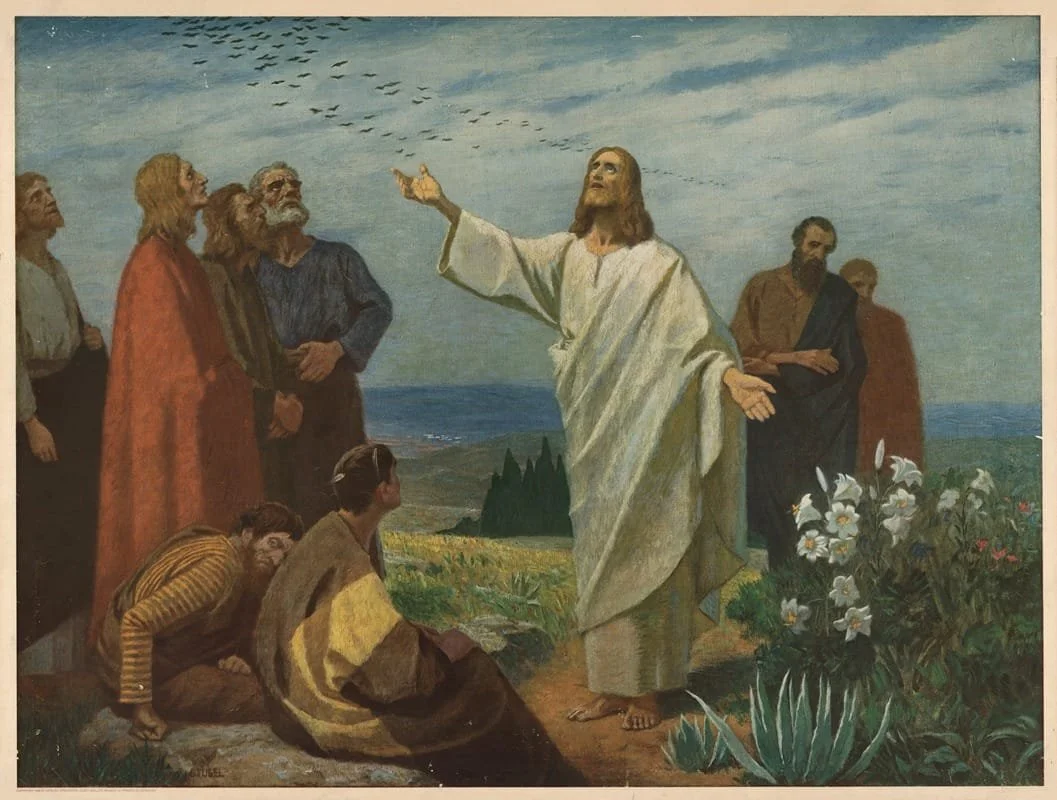
“The birds of the air and the lilies of the field” (1932) by Gebhard Fugel
“Fake it until you make it” is advice that I was given when I began in youth ministry and teaching. If I’m honest, I have likely given this advice to new catechists in an effort to ease their minds with the intention of communicating that they didn’t need to have all of the answers.
But the truth of the Gospel is too important to be communicated in a way that is erroneous or lacking. God is the true teacher. The catechist is the vessel who is inspired by God’s pedagogy. Christ is our guide.
Learning from the Divine Teacher
God’s pedagogy is rooted in love, with the goal of salvation for all of His people (CCC 74). In God’s perfect way, He meets His people where they are on their journey and gradually leads them into the fullness of His Revelation, which is realized in Jesus Christ.
Jesus became flesh to help us know God’s love, to save us, to be our model of holiness, and to allow us to share in the divine nature (CCC 457–460).
Catechesis follows God’s pedagogy through the perfect example of Jesus. Jesus used a variety of teaching methods in order to reach people. As catechists, we can look to the way He taught and ask ourselves how we can imitate Him.
Two qualities of Jesus’ pedagogy stand out to me in particular: He welcomed people where they were, and He modeled a life of prayer.
Jesus Began with Relationship
First, Jesus established trusting relationships with His disciples and followers. He was welcoming and accepting of people where they were in their lives. In this way, He earned trust and walked with others toward conversion.
We see this in the account of the woman caught in adultery. The Pharisees were ready to stone her based on the Mosaic Law. Jesus did not condemn or accuse her. Instead, He encountered her with mercy and then called her to a different way of life (John 8:1–11).
The goal is not simply for our students to know about God. We want them to enter into a relationship with Him—to know Him well enough that they can trust Him with the needs of their lives. That begins with trust. Catechists can model Jesus in this way by being approachable and loving to all people.
Is your classroom welcoming to all students?
Jesus Modeled Prayer
Second, Jesus did not simply teach His disciples about prayer. He modeled a personal prayer life for them.
After performing the miracle of feeding the five thousand, He prayed:
“After He had sent the crowds away, He went up on the mountain by Himself to pray; and when it was evening, He was there alone” (Matthew 14:23).
Before He chose His disciples, He prayed:
“It was at this time that He went off to the mountain to pray, and He spent the whole night in prayer to God” (Luke 6:12).
Before He suffered His Passion, He prayed:
“Then Jesus came with them to a place called Gethsemane, and said to His disciples, ‘Sit here while I go over there and pray’” (Matthew 26:36).
Jesus repeatedly withdrew to spend time with the Father. In order for catechists to pour love into others as Jesus did, we must spend time in prayer and allow ourselves to be filled with God’s love first. We cannot give what we have not received.
Is God calling you to dive more deeply into your personal prayer life?
No Need to “Fake It”
There is no need to “fake it until you make it.” Instead, catechists should prepare and “always be ready to give an explanation to anyone who asks you for a reason for your hope” (1 Peter 3:15).
Catechesis should be presented in a way that is clear and able to be applied to the lives of those we teach. There may be a temptation to cut corners or select the easiest methods of teaching when we lack understanding ourselves. Instead, catechists are challenged to dive deeper into their own understanding of the faith and to find different methods of teaching that can inspire different types of learners.
Ultimately, the catechist is an apprentice of God. We rely on the Lord to move and prepare the hearts of those we teach. God entrusts us with the incredible responsibility of transmitting His Divine Revelation and proclaiming the Good News.
We do not have to know everything. We do not have to be perfect teachers. But we should never have to fake it. We have the perfect Teacher to follow.
For Further Reading:
Catechism of the Catholic Church, paragraphs 74–100, 457–460
Directory for Catechesis, articles 157–165 — Divine pedagogy and the pedagogy of faith
General Directory for Catechesis, articles 137–147 — The pedagogy of God
National Directory for Catechesis, pp. 89–95 — The pedagogy of God and the pedagogy of Christ
Joseph White, “Children’s Catechesis: The Divine Pedagogy,” The Catechetical Review 1, no. 1 (January 2015)
Petroc Willey, "The Pedagogy of God Part 1," The Sower 30.2 [April 2009]
Petroc Willey, "The Pedagogy of God Part 2," The Sower 30.3 [July 2009]